
Quick Summary
Crystal healing properties are not supported by controlled research. Reviews of the available studies find no evidence that healing crystals work beyond a placebo effect, though people may still feel calmer through ritual and expectation.
- Reviews of available research find no reliable effect of healing crystals beyond placebo.
- Anecdotes and testimonials cannot establish that a stone caused a change.
- Systematic reviews and controlled trials are the strongest evidence for any health claim.
- Crystals should never replace or delay medical care from a licensed professional.
- Never drink water a stone has soaked in, since some minerals are soluble or hazardous.
Table of Contents
- What Crystal Healing Properties Are Supposed to Do
- Do Healing Crystals Work? Reviewing the Scientific Evidence
- Healing Crystals and the Placebo Effect
- Why Some People Still Feel Better With Crystals
- How to Use Healing Crystals as a Ritual or Personal Practice
- Are Healing Crystals Safe to Handle and Wear?
- Choosing a Crystal Piece Based on What You Want From It
- Frequently Asked Questions
What Crystal Healing Properties Are Supposed to Do
Last Updated: November 5, 2026
Crystal healing properties are the benefits people attribute to specific stones: calm, grounding, protection, emotional balance, or better sleep. Healthline describes crystal healing as a practice in which stones are believed to affect energy, emotions, and well-being, but notes that this belief rests on tradition and personal experience rather than scientific proof (Do Healing Crystals Work? Lore, History, Research).
This is a question people ask often. So let's separate what the claims say from what the evidence supports.
Most people buy healing crystals for one of a few reasons: a stone's traditional meaning appeals to them, they want a physical reminder of an intention, or the ritual of holding a stone feels settling. These are real experiences. The stone itself is usually not what produces them.
Crystal healing is not a substitute for medical care. EBSCO advises people to seek guidance from licensed medical professionals rather than relying solely on crystals for health concerns (Crystal healing | Complementary and Alternative Medicine | Research Starters).
Do Healing Crystals Work? Reviewing the Scientific Evidence
Healing crystals have no proven effect beyond the placebo response, according to the available reviews. Reviews of the available research have not found evidence that crystal healing works beyond a placebo effect. Learn how to check whether your crystals are genuine with at-home tests. That is the short answer. The more useful answer is to show how different kinds of evidence stack up, so you can judge a claim yourself instead of taking anyone's word for it.
A Clear Evidence Review by Study Type
Not all evidence is equal. Here is how the main types rank, from weakest to strongest, and what each can and cannot establish.
Anecdotes and testimonials. These describe how one person felt.
Ethnographic and qualitative research. Qualitative studies explain how people practice crystal healing and find meaning in it. This work is valuable for cultural context.
Observational studies. These track people over time without assigning a treatment.
Controlled trials. These are the strongest tool because they compare a group using the stone with a group that is not, ideally without either group knowing which is which.
Systematic reviews and meta-analyses. These pool multiple controlled trials and are the highest standard.
A Practical Checklist for Evaluating Health Claims
When you see a claim about a crystal's healing properties, run it through these questions. A claim that fails more than one is worth treating with skepticism. Practical tests for telling real crystals from fakes can help you check the stones themselves before trusting their properties.
- Is there a peer-reviewed study with a control group? A product page, a blog post, or a testimonial is not a study. Look for a journal name and a methods section.
- Does the claim name a specific outcome? "Supports emotional balance" is vague. "Reduces anxiety scores on a validated scale" is testable. Vague claims are hard to disprove, which is why they persist.
- Are testimonials doing the work of evidence? Anecdotes can illustrate an experience, but they cannot establish cause. Be wary when a seller's main proof is a set of reviews.
- Is there a conflict of interest? If the person making the claim also sells the stone, that does not make the claim false, but it is a reason to look for independent evidence.
- Does the claim ask you to delay or skip medical care? That is a red flag regardless of how the claim is worded.
Watch out: a claim that cites "quantum" or "vibrational" science without a specific, peer-reviewed study is using scientific-sounding language to borrow authority it has not earned.
Where the Claims About Energy and Mental Health Stand
Claims that crystals shift your energy field or balance your emotions are not supported by measurable evidence (Do Healing Crystals Work? Lore, History, Research). Healthline notes there is no scientific proof of these effects. That does not mean people never feel calmer while holding a stone. It means the calm can usually be explained without assuming the stone did the work, through expectation, ritual, attention, and the meaning you assign to the object. Those are real experiences. They are not evidence of intrinsic healing power.
Healing Crystals and the Placebo Effect
A placebo response happens when a person improves because they expect to, not because of the treatment itself. Crystal healing is a strong setting for this. Believing a stone will help, choosing it deliberately, and setting aside time to hold it can all shift how you feel.
This is why the placebo question matters for a buyer. A stone can be a meaningful object without being a medical one. Treat any change you feel as real, and also recognize that the stone's mineral composition is not what changed it.
Why Some People Still Feel Better With Crystals
Some people find crystals useful as a focusing tool. A stone in your pocket becomes a physical cue to slow down, check in with yourself, or set an intention for the day. That habit has value on its own, whatever the stone is made of.
NUUMITE (S012), travelers stone, metaphysical crystal →
Ritual also matters. Choosing a piece, cleansing it, and placing it somewhere you see daily can make a routine feel intentional. Some people describe this as calming, though this is a subjective experience rather than evidence of healing power.
How to Use Healing Crystals as a Ritual or Personal Practice
If crystals are part of your routine, keep the focus on the habit. Pick one stone and carry it in a pocket or set it on your desk. Hold it during a short pause in your day and name one thing you want to focus on.
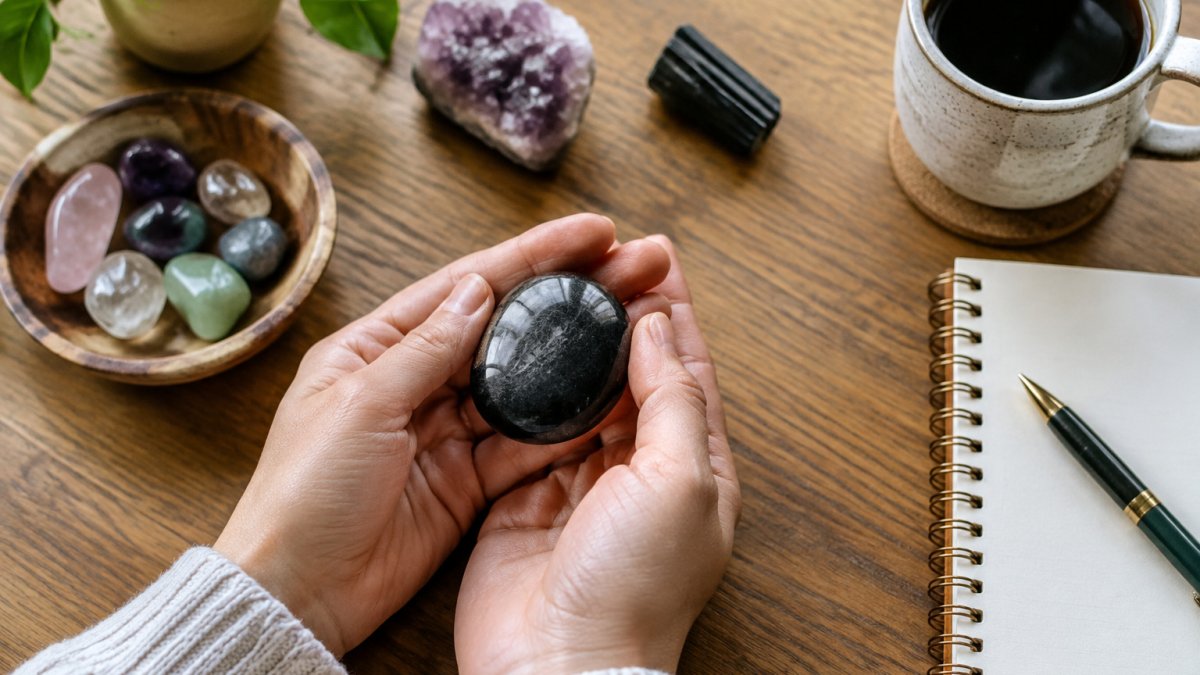
Clean your stones gently. Wipe them with a soft, dry cloth, and if you rinse them, use cool water and pat them dry. A practical reference on cleansing methods is available in our guide on How to Cleanse Healing Crystals: 6 Safe Methods.
Hold the purpose loosely. The ritual is a tool for attention, not a guarantee of results.
Are Healing Crystals Safe to Handle and Wear?
For most people, handling and wearing crystals is safe. The practical risks are mostly physical, but a few are worth knowing before you buy, wear, or ingest anything. This is the part most crystal guides skip.
Physical Handling and Wear
Crystals can chip, scratch, or be damaged by water and chemicals. Some stones are soft or porous, so check hardness and care instructions before wearing a piece daily. If you have skin sensitivities, check the metal settings and cords of your jewelry, not just the stone. For guidance on cleansing stone jewelry without damage, see How to Cleanse Healing Stone Jewelry: A Safe Guide.
Ingestion and Crystal-Infused Water
Putting stones in drinking water is a common practice, and it is the riskiest one. Some minerals are soluble or contain elements you do not want to ingest, and a stone that is safe to hold is not necessarily safe to drink from. Polished stones may carry residues from cutting and polishing. If you want the ritual of setting an intention with water, place the stone beside the glass rather than in it. Do not drink water that has had unknown stones soaking in it, and do not give such water to children or pets.
Dust From Cutting and Polishing
Cutting, grinding, or polishing stone creates fine dust. Some mineral dust is a respiratory irritant, and a few materials contain harmful elements. If you work with raw stone, do it wet or with ventilation and wear a fitted respirator, not a loose dust mask. Hobbyists who tumble stones at home should keep the equipment away from living areas and clean up with a wet method rather than dry sweeping.
Unsafe Mineral Identification
Not every stone sold as a healing crystal is what it claims to be. Some materials are mislabeled, and a few naturally occurring minerals are hazardous to handle or ingest. If you are unsure what a stone is, do not grind it, do not put it in water you will drink, and do not give it to a child who might put it in their mouth. A local lapidary club or a geology department can often help identify a specimen.
When to Seek Medical Care
Stones are not a replacement for medical treatment. If you have a health concern, see a licensed medical professional first. Do not use a crystal to delay a diagnosis, skip a prescribed treatment, or manage a condition that needs monitoring. A stone can sit alongside your care as a personal ritual; it should not sit in front of it.
Watch out: a seller who suggests a stone can replace medication, or who discourages you from seeing a doctor, is giving advice that goes beyond anything the evidence supports.
The practical risks of handling, wearing, and ingesting crystals differ, and the main ones are worth knowing before you buy.
| Risk | Cause | Precaution |
|---|---|---|
| Physical damage | Chipping, scratching, water or chemical exposure | Check hardness and care instructions before daily wear |
| Skin sensitivity | Metal settings and cords on jewelry | Check settings and cords, not just the stone |
| Ingestion risk | Soluble minerals and polishing residues | Place stone beside the glass, not in drinking water |
| Respiratory irritation | Fine dust from cutting and polishing | Work wet or ventilated and wear a fitted respirator |
| Mislabeled stones | Some stones sold as healing crystals are not what they claim | Do not grind, drink from, or give to children if unidentified |
Choosing a Crystal Piece Based on What You Want From It
Choose a crystal for the experience you want, not for a promised outcome. If you want a grounding object for daily use, a tumbled black tourmaline pocket stone is an easy place to start. Our Black Tourmaline Tumbled Pocket Stone is about ¾ to 1 inch, sold one stone per order, with natural variation in each piece.

Be realistic about what a stone can do. Buy it because you like how it looks and how it fits into your routine, and treat any calm you feel as a pleasant side effect of the practice itself.
Frequently Asked Questions
Are crystal healing properties scientifically proven?
No. Reviews of the available research have not found that crystals produce healing effects beyond placebo. Reviews of the available research have not found scientific proof that crystals significantly affect energy, emotions or mental health, or evidence that crystal healing works beyond a placebo effect. Studies that do exist are often small, anecdotal or focused on the meaning people attach to crystals rather than on measurable physical outcomes. Crystals can still be a meaningful personal practice, but the evidence does not support claims that they heal.
Can crystals help with stress or anxiety?
Crystals may feel calming, and that feeling can be real even though it does not come from the stone itself. Holding a smooth stone, following a ritual or setting an intention can create a sense of routine and focus. Those effects are subjective and the research on them is limited. If stress or anxiety is affecting your daily life, speak with a licensed health professional. Crystals work best as a complement to, not a replacement for, professional care.
Can crystals replace medical treatment?
No. Crystal healing should not replace medical care for any health condition. EBSCO advises seeking guidance from licensed medical professionals rather than relying solely on crystal healing for health issues. If you have symptoms that concern you, book an appointment with your doctor or another qualified provider first. You can keep using a crystal as part of a personal wellness routine alongside any treatment your provider recommends.
Are healing crystals safe to use?
Most polished crystals are safe to carry, wear or keep at home. Handle them with basic care: avoid soaking stones that are sensitive to water, do not use salt water on iron-rich stones such as black tourmaline, and keep them away from children who might swallow small pieces. Check that jewelry settings are secure and that stones are not chipped. Wash your hands after handling stones that are dusty or treated.