
Table of Contents
- How to Verify Crystal Authenticity With Non-Destructive Tests First
- Crystal Authenticity Tests: Visual Inspection, Inclusions, and Surface Clues
- How to Identify a Crystal With a Flashlight and UV Light
- Natural Crystal vs. Glass: Weight, Temperature, and Hardness Checks
- How to Identify Crystals at Home Without Damaging Them
- Treatments, Synthetics, Simulants, and Composites to Watch For
- When to See a Gemologist and What Documentation to Ask For
- Conclusion
- Frequently Asked Questions
Last Updated: October 13, 2026
How to Verify Crystal Authenticity With Non-Destructive Tests First
Learning how to verify crystal authenticity starts with the safest checks. At GCDJewelry, we handle natural gemstones daily and always inspect before we test.
A scratch test can permanently damage a soft stone, and a hot needle can burn a treated specimen.
Below are seven checks you can do at home, plus the warning signs that mean you should see a professional.
Why You Should Start With the Safest Checks
Real crystals are fragile in ways glass is not. Quartz, amethyst, and selenite sit at different spots on the Mohs scale, and a test that suits one can scar another.
Non-destructive verification also protects value: a scratched specimen loses appeal, and damaged crystal jewelry loses resale potential.
The Gemological Institute of America's gem identification overview explains that most identification work relies on observation and light before any instrument touches the stone.
What to Set Up Before You Begin
Good lighting and a few simple tools make every test easier.
- A bright flashlight or phone light
- A magnifying glass or jeweler's loupe
- A glass of water
Work on a soft cloth so a dropped stone lands safely instead of chipping.
Crystal Authenticity Tests: Visual Inspection, Inclusions, and Surface Clues
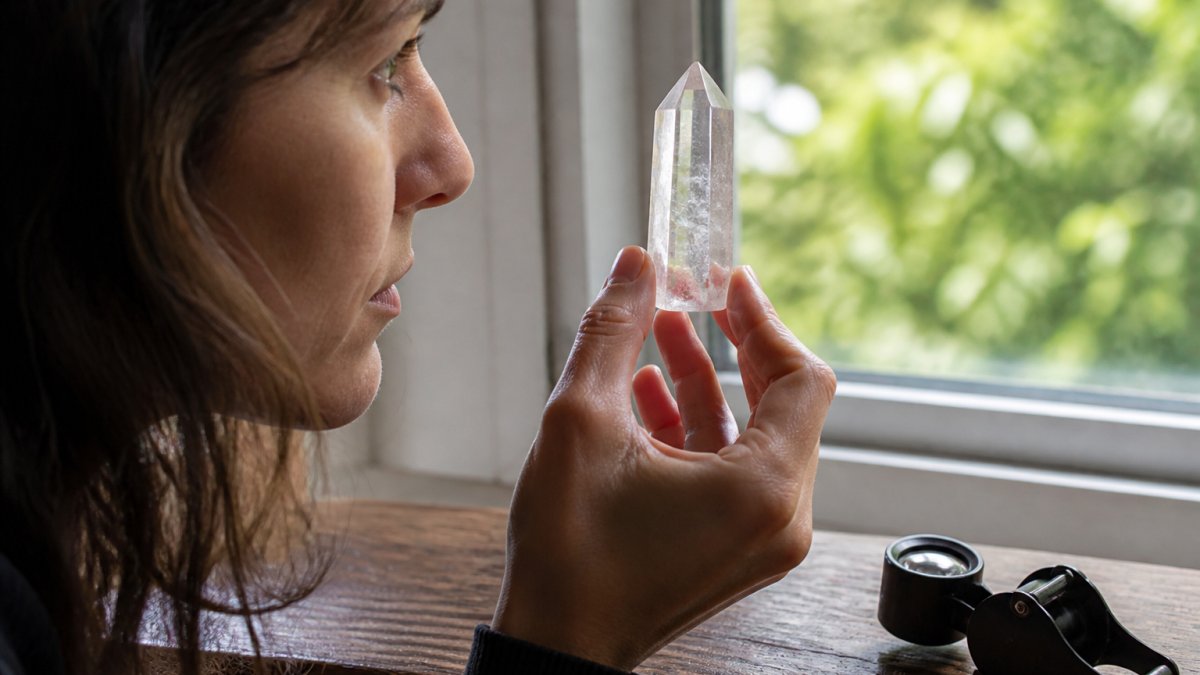
Visual inspection is the fastest way to spot an imitation. Real stones carry small flaws that glass rarely copies well, your best clue.
Reading Color, Clarity, and Internal Patterns
Natural crystal color is usually uneven. Amethyst often deepens toward the tip.
Perfect, uniform color across a large stone is a red flag. So is flawless clarity at a low price.
Look for inclusions, the tiny trapped minerals, bubbles, or lines inside a stone. Natural inclusions look random. They follow no pattern.
Luster, Fracture, and Cleavage
Luster is how a surface reflects light. Real quartz has a glassy shine. Plastic looks dull or waxy.
Fracture and cleavage describe how a stone breaks. Real minerals split along natural planes; glass breaks in smooth, curved chips called conchoidal fractures.
Run your fingertip along an edge. Natural stones feel slightly irregular. Molded glass feels perfectly smooth.
How to Identify a Crystal With a Flashlight and UV Light
A flashlight is the most useful tool you already own, showing you inside the stone without touching it. UV light adds a second layer of information, but both tests are clues, not verdicts.
Using a Standard Flashlight for Transparency and Bubbles
Hold the light against the stone in a dark room and watch how far the glow travels.
- Real quartz and amethyst usually pass light evenly, with color zoning that shifts across the stone
- Glass often shows round bubbles trapped inside
- Dyed stones show color pooling in cracks and along fracture lines
Round bubbles are the clearest sign of glass, since natural crystals almost never contain perfectly round air bubbles. But not all glass imitations have visible bubbles: well-made glass can be bubble-free, and some fast-forming natural stones trap roundish gas pockets.
Practical rules for reading the flashlight test:
- Use the brightest, narrowest beam you have. A focused phone light beats a wide lamp.
- Rotate the stone. Inclusions look different from every angle; a single view can mislead.
- Compare against a known real stone of the same type. Context beats absolutes.
Ultraviolet Fluorescence and What It Can and Cannot Tell You
Some natural stones glow under UV light. Others do not. That is the problem with this test.
Many genuine crystals show no fluorescence and many synthetics glow brightly, so a glow or its absence proves little on its own.
What UV light can do is sort stones into groups once you already suspect the type:
- Amethyst from some sources shows a weak to moderate blue or violet glow; other sources show none.
- Ruby and sapphire (corundum) often fluoresce red under longwave UV, and this is one of the few cases where a strong reaction is genuinely informative.
- Diamond sometimes fluoresces blue, but many natural diamonds are inert, and lab-grown diamonds can behave the same way.
A common false positive: a brightly glowing stone is assumed real, when many synthetic and treated materials are engineered to fluoresce.
Use UV light as one clue among several. Never as a verdict.
Natural Crystal vs. Glass: Weight, Temperature, and Hardness Checks
Natural crystal vs. glass comes down to three physical traits: weight, temperature, and hardness. Each is easy to check, and each has limits.
Weight and Density Comparison
Real stones feel heavier than they look. Glass and plastic feel light for their size.
Hold a suspected stone in one hand and a known real one of similar size in the other, the difference is often obvious. On a kitchen scale, natural minerals are denser and pack more mass into the same volume.
| Check | Real Crystal | Glass or Plastic |
|---|---|---|
| Weight for size | Feels dense and solid | Feels light |
| Temperature | Stays cool longer | Warms up fast |
| Bubbles inside | Rare or none | Often round bubbles |
| Color | Uneven, natural | Uniform, flat |
| Edges | Slightly irregular | Perfectly smooth |
Cool-to-the-Touch and Mohs Scale Scratch Testing
Real stones pull heat from your skin, so they feel cool at first touch, while glass warms quickly.
The Mohs scale ranks minerals by hardness: quartz sits at 7 and glass around 5.5, so quartz can scratch glass but not the reverse.
The catch: a scratch test damages the softer material, so only test a hidden spot and never a finished piece of crystal jewelry.
How to Identify Crystals at Home Without Damaging Them
You can identify most stones at home using only light, weight, and a magnifier. Save aggressive tests for the lab.
Here is our safe order of operations:
- Clean the stone with a soft cloth
- Check color and clarity in daylight
- Look for inclusions with a loupe
- Shine a flashlight through it in a dark room
- Compare weight against a known stone
- Check temperature at first touch
- Try UV light as a final clue
If a stone passes all seven, you have good reason to trust it.
Notice what is missing: no scratching, heating, or acid. Those tests belong to a professional with the right tools.
Treatments, Synthetics, Simulants, and Composites to Watch For
Not every questionable stone is fake. Many are real minerals that have been altered, grown in a lab, or assembled from pieces. That distinction matters, because sellers often blur it and price depends on the category.
Here is how the four categories actually differ.
Treated Natural Stones
A treated stone started as a real mineral and was changed to improve its color, clarity, or durability. It is still natural in origin, but no longer in its natural state.
- Dyeing: color forced into cracks and pores, common in agate, howlite, and quartz. Look for color that pools in fractures and looks darker along crack lines.
- Heat treatment: amethyst heated to mimic citrine, or sapphire heated to deepen blue. Heat treatment is stable and widely accepted in the trade, but it should still be disclosed.
- Irradiation: used to darken or change color in some quartz and topaz. The change is usually permanent but should be disclosed.
A dyed stone is still a stone, but it is not an untreated natural crystal and should not be priced like one.
Synthetics (Lab-Grown)
A synthetic has the same chemical composition and crystal structure as the natural mineral, just grown in a lab instead of the earth.
This is the category buyers most often miss. A synthetic amethyst can pass hardness, temperature, and visual tests because chemically it is amethyst.
If a seller says 'real amethyst' at a price far below market, the stone may be synthetic rather than fake, both worth knowing about, but not the same problem.
Simulants (Imitations)
A simulant is a different material made to look like a target stone: glass shaped like quartz, cubic zirconia sold as diamond, and plastic molded into crystal points.
Simulants are the easiest category to catch at home, because their physical properties differ from the real thing:
- Glass is softer than quartz (about 5.5 vs. 7 on the Mohs scale)
- Glass and plastic are less dense, so they feel light for their size
- Simulants often show round bubbles, uniform color, and perfectly smooth molded edges
Composites and Assembled Stones
A composite is made from real stone fragments bonded with resin, or from two materials joined together, for example, a thin slice of natural stone glued to a glass or plastic backing.
Composites are the hardest to spot without magnification. Look for:
- A visible seam or glue line where two materials meet
- A color or texture change at the boundary
- A backing that looks different from the face of the stone
A Practical Question to Ask Any Seller
A simple question helps: 'Is this natural, treated, synthetic, or assembled?' A straight answer is a good sign; a vague one is not.
Ask specifically about:
- Whether the stone is natural or lab-grown
- Whether it has been dyed, heated, irradiated, or filled
- Whether it is a single stone or an assembled piece
A seller who cannot answer these clearly is a bigger risk than any single test result.
When to See a Gemologist and What Documentation to Ask For
At-home tests narrow things down. They cannot confirm a stone's identity with certainty.
A gemologist uses a refractometer, a microscope, and specific gravity measurements to read properties no home test can match.
Ask any seller for:
- A written description of the stone
- Disclosure of any treatments
- A return policy in writing
At GCDJewelry, every piece is handcrafted in Ontario using natural gemstones, and we are happy to talk through what is in each design.
For deeper reading, the Canadian Gemmological Association's resources on gem identification covers how trained gemologists assess stones. And the International Gem Society's guide to identifying crystals offers more detail on the tests we covered here.
Conclusion
Spotting a fake takes patience, not expensive gear. Start with your eyes, add light and weight, and save harsh tests for a professional. If a deal feels too good, it usually is.
When you want stones you can trust, GCDJewelry handcrafts every piece in Ontario using natural gemstones. Our designs are made for daily wear, easy to style, and built to help you feel your best.
Frequently Asked Questions
How do I tell if my crystal is real or fake?
Start with non-destructive checks: look for natural inclusions, color zoning, and surface texture under a loupe. Real quartz and amethyst typically show internal patterns and slight imperfections, while glass imitations often look too uniform or contain round bubbles. Test weight and cool-to-the-touch feel next. If the stone is set in jewelry or you suspect treatment, ask a gemologist to confirm before relying on any single test.
How to tell if a crystal is real with a flashlight?
Hold a bright flashlight directly against the stone in a dark room. Natural crystals usually show uneven internal patterns, fractures, or color zoning, while glass or synthetic stones often look perfectly clear with tiny round bubbles. For stones like amber or some fluorite, ultraviolet light may cause fluorescence. A flashlight reveals internal structure but cannot confirm hardness or density, so pair it with other checks.
Which tests can damage crystal jewelry?
Scratch tests using the Mohs scale can leave permanent marks, especially on softer stones like selenite or fluorite. Heating a stone to test temperature, dropping it to check fracture, or applying acid can also cause damage. Skip destructive tests on finished jewelry. Stick to visual inspection, weight comparison, and flashlight checks first, then let a gemologist handle anything that needs a scratch or refractive index test.
When should I ask a gemologist to verify a crystal?
If the stone is valuable, set in gold or silver, or sold as a specific variety like amethyst or pyrite, professional verification is worth it. A gemologist can use a refractometer, specific gravity test, and magnification to confirm identity without damage. Ask for written documentation, especially for gifts or high-value pieces. At-home tests are useful for a first pass but cannot replace lab-grade analysis.