
Last Updated: November 4, 2026
Quick Summary
Start with one or two crystals rather than a full display, and choose pieces whose colors echo your existing neutrals. Place each stone with room around it, keeping any grouping to three objects or fewer so the space stays calm. A minimalist style depends on restraint, so fewer, better-chosen pieces look more intentional.
- Begin with one statement crystal and one smaller accent piece.
- Limit each space to one bold color accent and two neutral tones.
- Keep any display grouping to three objects or fewer.
- Scale a shelf crystal to roughly one-third the height of nearby objects.
- Use a tray for entryway pieces and for easier cleaning.
Table of Contents
- Start With a Small, Curated Selection of Crystals
- Choose Pieces That Fit a Clean Color and Texture Palette
- Place Crystals Room by Room Without Creating Clutter
- How to Style Crystal Jewelry in Everyday Outfits
- Crystal Jewelry for Everyday Wear: Durability and Care
- How to Layer Crystal Necklaces Without Overcrowding
- Pick Your First Minimalist Crystal Piece This Week
- Frequently Asked Questions
Minimalist interiors are built on restraint, and a few well-chosen crystals can add warmth and texture without undoing that calm. Fewer, better pieces tend to look more intentional than a crowded collection. Learning how to incorporate crystals into a minimalist style comes down to choosing carefully, placing deliberately, and leaving room around each piece.
Canadian Consumer Handbook on home décor and product care
Start With a Small, Curated Selection of Crystals
The simplest way to keep a minimalist space calm is to start with one or two crystals rather than a full display. A single raw cluster or a polished sphere carries more visual weight than a dozen small stones scattered together.
Before buying more, step back and look at what you already own. Ask which piece you reach for most often and why. That piece is usually the right starting point.
- Choose one statement crystal for your main surface
- Add one smaller accent piece for balance
- Leave the rest of the room open
If you want to wear stones as well as display them, browse our handmade crystal necklaces to find a single piece that suits your everyday look.
Choose Pieces That Fit a Clean Color and Texture Palette
Minimalism relies on a limited palette, so crystals work best when their colors echo the room. Soft whites, grays, and warm neutrals blend easily, while a deep amethyst or bright citrine can become the focal point of a neutral space. Texture matters just as much as color: a smooth polished stone sits well beside matte ceramic and natural wood, while a rough raw crystal adds contrast to sleek surfaces.
Rather than eyeballing it, use a simple three-step editing framework to keep the palette intentional. First, pull three to five objects from the room that already feel right, a ceramic mug, a linen throw, a wood bowl, and note their dominant tones and finishes. Second, choose one crystal whose color repeats one of those tones and whose finish contrasts with at least one other object. Third, remove anything that introduces a fourth distinct color or a second competing focal point. This method gives you a repeatable test: if a new piece does not echo an existing tone or add a deliberate contrast, it stays out.
A common pattern is to limit each surface to one bold color accent and keep the rest within two neutral tones. For example, a warm gray room can carry a single deep amethyst point as the accent, with a clear quartz sphere and a matte black ceramic tray as the supporting neutrals. If you prefer a quieter look, choose stones in the same family, milky quartz, moonstone, and pale rose quartz, and vary only the texture between raw and polished.
- Match stone tones to your existing neutrals
- Pair smooth finishes with matte or natural textures
- Limit each space to one bold color accent
- Use the three-step edit: sample existing tones, choose one echo plus one contrast, remove the fourth color
Place Crystals Room by Room Without Creating Clutter
Each room has its own job, so each room calls for a different kind of placement. Thinking room by room keeps a display from spreading across the whole house. The key variables are scale, function, and sightlines: a piece that reads well on a deep living-room shelf may overwhelm a narrow entryway console, and a crystal placed where you set down keys will get knocked more often than one on a high shelf.
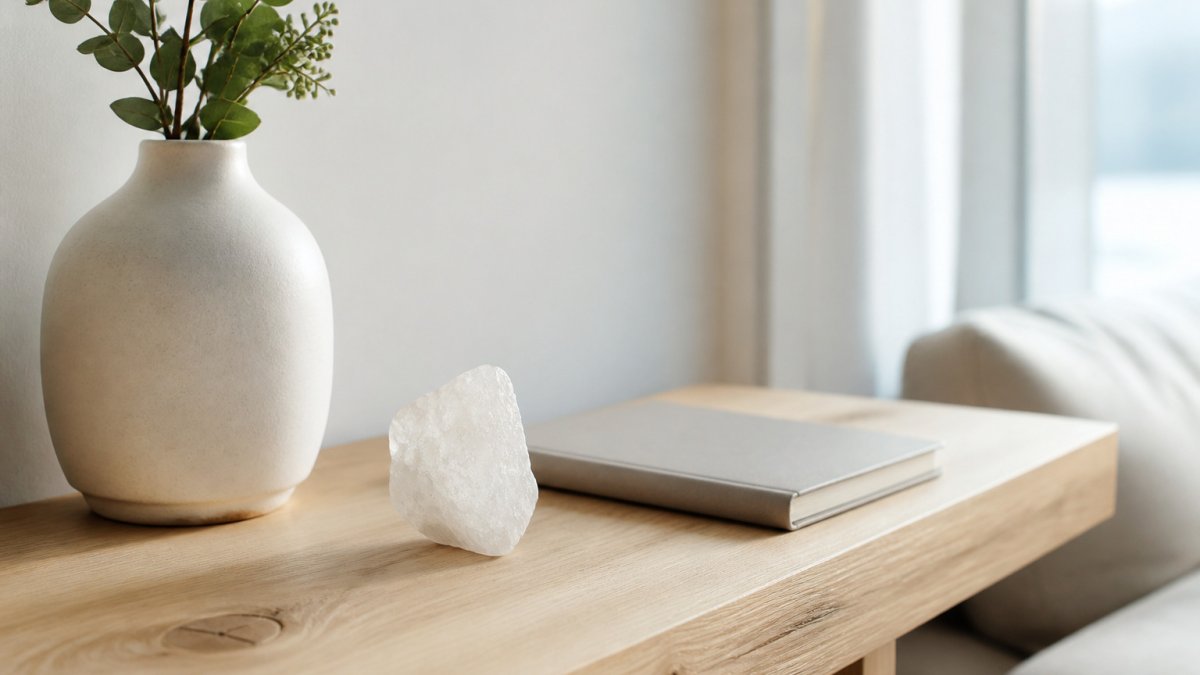
A single raw crystal placed beside a ceramic vase and a closed notebook on a light wood shelf can anchor a living room without making it busy. Keep the arrangement to three objects or fewer so the eye can rest.
Entryway. The entryway is a high-traffic zone, so choose one small, stable piece on a tray or a shallow bowl rather than a cluster of loose stones. A palm-sized polished stone or a small cluster on a tray near the door reads as deliberate and is easy to lift when you clean. Avoid placing anything fragile where bags and keys land.
Living room. This is where a statement piece earns its place. Scale the crystal to the shelf or table: a sphere or cluster roughly one-third the height of the surrounding objects feels balanced, while a tiny stone beside a large vase disappears. Keep the three-object rule and leave open space on either side so the eye can rest.
Bedroom. Bedside tables are small, so a single small stone or a tiny tray grouping works better than a large specimen. Place it where you will not reach for it in the dark, and keep it away from the edge if you have pets or young children. A smooth polished stone is less likely to snag bedding than a jagged raw cluster.
Workspace. On a desk, function comes first: put the crystal at the back corner or on a small tray so it does not compete with your keyboard, mouse, and notebook. A pocket stone or a small sphere at the edge of your sightline gives you a visual anchor without taking up working space.
Pendant canyon gray marble and black onyx, stone pendant, marble round disc →
Shelves, Tables and Trays
Shelves and side tables suit small groupings. Set a crystal on a tray so it reads as one deliberate object rather than something left behind. A tray also makes it easy to move the display when you clean. On open shelves, vary height rather than crowding: one taller point, one lower sphere, and one flat tray create a triangle the eye can follow.
Small Spaces and Renter-Friendly Setups
You do not need wall installations to make crystals work. A desk, a bedside table, or a windowsill is enough. Because these pieces sit on surfaces, they are easy to rearrange if you move or change your mind. For renters, choose freestanding pieces and removable adhesive putty for lightweight stones on narrow ledges; avoid drilling or permanent mounts. Keep total surface coverage to roughly one-third of any shelf so the display still reads as minimal.
- Scale the piece to the surface and the objects around it
- Keep high-traffic zones to one stable piece on a tray
- Leave open space on at least two sides of any grouping
- Use removable putty instead of permanent mounts in rentals
Each room calls for a different kind of placement, so the article's room-by-room guidance is easiest to scan at a glance.
| Room | Placement guidance | Key tip |
|---|---|---|
| Entryway | One small, stable piece on a tray | Avoid spots where bags and keys land |
| Living room | Piece roughly one-third the height of nearby objects | Leave open space on either side |
| Bedroom | Single small stone or tiny tray grouping | Keep out of reach in the dark |
| Workspace | Back corner or small tray | Keep clear of keyboard and mouse |
| Shelves and tables | Vary height: tall, low and flat | Use a tray for easy cleaning |
| Renters | Freestanding pieces and removable putty | Avoid drilling or permanent mounts |
How to Style Crystal Jewelry in Everyday Outfits
Crystal jewelry follows the same minimalist logic as home decor. One stone, worn with simple clothing, lets the piece stand out without competing with other accessories.
Pair a small pendant with a plain t-shirt or a tailored blouse. Avoid stacking several bold stones at once if your outfit already has a strong pattern.
Our rose quartz heart pendant is a simple choice for this look. It comes with an 18” faux leather cord.

Crystal Jewelry for Everyday Wear: Durability and Care
Minimalist pieces get worn daily, so care matters. Our complete guide to healing stone jewelry for daily wear covers day-to-day care in more detail. Most natural stones need gentle handling. Softer stones can scratch if stored with harder materials, and some scratch or chip from knocks against hard surfaces.
Wipe pieces with a soft, dry cloth after wear. For more on how artisanal crystal jewelry holds up to everyday use, see our guide to crystal jewelry designed for daily wear. Avoid prolonged water exposure and harsh chemicals. Store each piece separately to protect the natural stone.
- Remove jewelry before swimming, showering, or exercising
- Store stones apart to prevent scratches
- Clean gently with a dry cloth
How to Layer Crystal Necklaces Without Overcrowding
Layering can look effortless, but it is easy to overdo. Keep to two necklaces at most, and vary the lengths so each piece has its own space.
Choose one longer chain and one shorter one. Let the stones sit at different points on your chest rather than on top of each other.
Pick Your First Minimalist Crystal Piece This Week
Start small. Choose one crystal for a shelf or one necklace for daily wear, and live with it for a week before adding anything else. Our step-by-step guide to buying handmade crystal necklaces online walks you through choosing your first piece. You will quickly see whether the piece fits your space and your style.
Ready to begin? Explore the Black Moonstone Pocket Stone for a simple desk or pocket companion.
Frequently Asked Questions
How do you style crystals with a minimalist outfit?
Keep the outfit itself simple, with solid colours and clean lines, and let one crystal piece be the focal point. A single pendant or a slim bracelet in a stone such as rose quartz or black onyx reads as deliberate when the rest of the look is quiet. Match the metal of the crystal to your everyday jewelry, whether gold or silver, so the piece feels like part of a cohesive wardrobe rather than an add-on. Avoid pairing a bold statement crystal with other busy accessories on the same day.
How can you wear crystal jewelry without making an outfit look busy?
Limit yourself to one crystal item at a time, or two at most if they share a similar size and colour family. Choose delicate chains or lightweight pieces over chunky ones, and leave the rest of your accessories minimal. A pendant such as the Pendant canyon gray marble and black onyx stone pendant, priced at $17.00, works well because its simple disc shape keeps the look understated. Balance the visual weight of the crystal against your neckline and hairstyle so nothing competes for attention.
What is the easiest way to add a crystal accent to everyday style?
Start with a single earring or pendant you can wear daily, so the crystal becomes a habit rather than an occasion piece. The Peach Moonstone and Opalite Dangle Earrings, priced at $23.00, are an example of a light, everyday option with sterling silver lever-back hooks. Pair them with neutral clothing and let the soft colour of the stone be the only accent in your look.