
Table of Contents
- Why Artisanal Crystal Jewelry Belongs in Your Daily Rotation
- Durable Healing Stone Jewelry: What Actually Survives Daily Wear
- Choosing Artisanal Crystal Jewelry for Daily Wear: A Practical Buying Guide
- How to Style Crystal Necklaces for Work and Weekends
- Handcrafted Gemstone Jewelry Care Tips for Long-Lasting Shine
- Cleansing and Charging Your Crystals: Simple Rituals That Fit Real Life
- Frequently Asked Questions
Last Updated: September 23, 2026
Why Artisanal Crystal Jewelry Belongs in Your Daily Rotation
Artisanal crystal jewelry for daily wear is handcrafted gemstone jewelry designed to be worn continuously, not saved for special occasions. At GCDJewelry, we've watched that category shift from a niche interest to a genuine staple. The shift makes sense. A piece you wear every day carries your intention with it, whether that intention is calm, clarity, or simply a color you love against your skin.
Durable Healing Stone Jewelry: What Actually Survives Daily Wear
Durable healing stone jewelry is jewelry where the stone's hardness, the setting's construction, and the material's water resistance all match the way you actually wear it. Get one of those three wrong and the piece fails early.
Mohs Hardness and Everyday Durability
The Mohs hardness scale rates mineral scratch resistance from 1 (talc) to 10 (diamond). It's the single most useful number when you're shopping. A stone rated 7 or higher, like quartz, amethyst, or agate, handles daily knocks well. Softer stones such as fluorite or calcite scratch and dull quickly in a ring or bracelet, though they hold up fine in a pendant that rarely touches anything.
Water, Sweat, and Real-Life Wear Testing
Water and sweat are the quiet killers of crystal jewelry. Prolonged moisture weakens elastic cord, tarnishes some metal finishes, and can dull a polished surface over time.
| Stone | Mohs Hardness | Daily Wear Verdict | Best Setting |
|---|---|---|---|
| Quartz | 7 | Excellent | Bezel or prong |
| Amethyst | 7 | Excellent | Bezel or prong |
| Agate | 6.5-7 | Very good | Bezel |
| Moonstone | 6-6.5 | Good, handle with care | Bezel |
| Fluorite | 4 | Pendant only | Protected prong |
Choosing Artisanal Crystal Jewelry for Daily Wear: A Practical Buying Guide
Choosing artisanal crystal jewelry for daily wear comes down to three checks: stone authenticity, setting construction, and who actually made it. Run all three before you buy, and you avoid most of the disappointment that comes with online crystal shopping.
Genuine vs. Synthetic Stones: What to Check
Genuine stones show natural inclusions, slight color variation, and small imperfections. Glass and dyed synthetics look uniformly perfect, often too perfect. Ask the seller directly whether the stone is natural, treated, or synthetic, and whether the treatment is disclosed.
Handcrafted vs. Mass-Produced: What You're Paying For
Handcrafted jewelry costs more because a person selected the stone, set it by hand, and checked the finish. Mass-produced pieces are assembled on a line with whatever stone is cheapest that week.
How to Style Crystal Necklaces for Work and Weekends
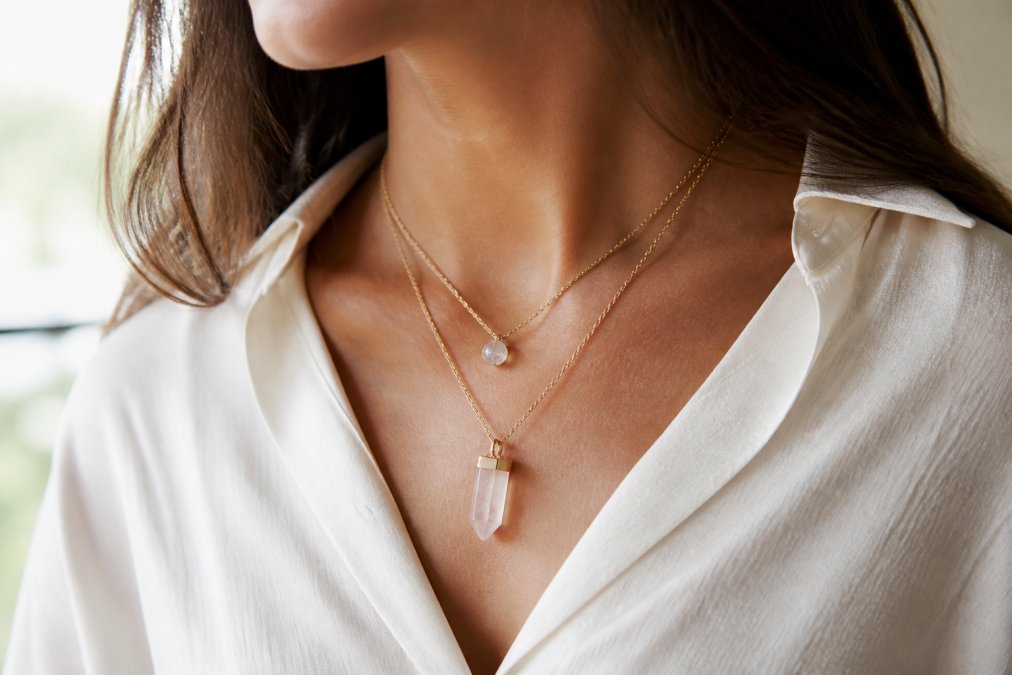
Styling crystal necklaces for work and weekends is easier than it sounds: keep the metal tone consistent, keep the pendant near your collarbone, and let one stone lead. A single quartz pendant on a fine chain reads polished in a meeting. Add a second, shorter chain for weekends without changing the outfit.
Styling Crystals for a Professional Environment
- Stone size: Keep the pendant under roughly 15 mm for office wear. Anything larger reads as a statement piece and pulls attention away from you.
- Metal tone: Match your other hardware, watch, rings, bag clasp. Mixed metals can work, but only when the mix is deliberate and repeated across at least two pieces.
- Chain weight: A 1 mm to 1.5 mm cable or box chain disappears against a blouse. A 3 mm chain competes with a collar.
- Color: Muted and translucent stones, clear quartz, rose quartz, smoky quartz, moonstone, sit closer to fine jewelry than saturated or opaque stones do. Save amethyst, malachite, and lapis for weekends or creative workplaces.
Layering and Stacking Without the Clutter
Layering works when the lengths differ by at least two centimeters and the stones share a color family. Stack bracelets on one wrist, not both, and cap it at three. Beyond that, the stack starts to look like inventory rather than style.
Weekend and Off-Duty Styling
Weekends are where you can break the office rules. Layer a chunky raw amethyst point over a linen shirt. Stack four or five beaded bracelets if you want. Pair a bold malachite pendant with a plain white tee so the stone does the work.
Matching Stones to Outfits
A simple mapping saves decision fatigue:
- Neutral outfit (black, white, gray, cream): any stone works. This is your chance to wear the saturated pieces.
- Warm palette (rust, olive, camel): smoky quartz, citrine, tiger's eye, and warm-toned agate.
- Cool palette (navy, slate, cool gray): clear quartz, moonstone, amethyst, labradorite.
- Busy print: one stone, one metal, no layering. Let the print lead.
For professional settings, choose smaller stones in muted tones. Rose quartz, smoky quartz, and clear quartz all read as understated. Save the bold, saturated pieces for weekends.
Handcrafted Gemstone Jewelry Care Tips for Long-Lasting Shine
Handcrafted gemstone jewelry care comes down to a short weekly habit: wipe, dry, store separately. That's it. Most damage comes from moisture left sitting on metal and stones, not from wearing the piece.
- Wipe each piece with a soft dry cloth after wearing
- Remove jewelry before showering, swimming, or applying lotion
- Store pieces in separate pouches so stones don't scratch each other
- Restring elastic bracelets every 12 to 18 months if worn daily
- Avoid ultrasonic cleaners on soft or treated stones
Cleansing and Charging Your Crystals: Simple Rituals That Fit Real Life
Cleansing and charging your crystals doesn't require a full moon or a complicated setup. Set the piece on a windowsill in daylight for a few hours, or pass it through incense smoke. Both are quick, and both fit a busy week.
Which Stones Can Take Water (and Which Can't)
Water is not neutral. It reacts with certain minerals, dissolves others, and gets trapped inside porous structures where it sits and dulls the surface.
Safe in water:
- Quartz (clear, rose, smoky, amethyst)
- Agate and chalcedony
- Jasper
- Garnet
Not safe in water:
- Selenite and gypsum: water-soluble. A rinse will pit and eventually dissolve the surface.
- Halite (rock salt): dissolves outright.
- Malachite: porous and copper-based; water accelerates tarnish and can dull the polish.
- Lapis lazuli: porous, and the pyrite inclusions can rust.
- Opal: contains water in its structure; soaking can cause crazing.
- Pyrite: rusts.
- Mica and layered stones: water seeps between layers and causes flaking.
Cleansing Methods, Ranked by What They Actually Do
- Dry cloth wipe: removes skin oils and dust. Do this daily. It's the single highest-value habit.
- Smoke (incense, palo santo, dried herbs): no moisture, works for any stone. Pass the piece through the smoke for 20 to 30 seconds.
- Sound (singing bowl, bell, tuning fork): no moisture, no contact. Hold the piece near the source for a minute or two.
- Selenite or quartz charging plate: no moisture. Rest the piece on the plate overnight.
- Cool water rinse: safe only for the water-safe list above. Pat dry immediately, don't let it air-dry, because standing water leaves mineral spots.
- Salt or saltwater: avoid for anything with metal findings. Salt corrodes sterling silver and plated metals, and it scratches softer stones.
- Sunlight: fine for quartz family stones. Skip for amethyst, rose quartz, and smoky quartz, which can fade with prolonged UV exposure.
- Moonlight: safe for everything, no UV fade risk. Slower, but the safest option for colored stones.
Charging With Intention
For charging, hold the piece and state your intention plainly. Some people use moonlight, others use sound. The method matters less than doing it consistently with a clear purpose.
A practical rhythm that fits a real week:
- Daily: dry-cloth wipe after wearing.
- Weekly: smoke or sound cleanse, five minutes.
- Monthly: full charge on a windowsill or selenite plate overnight.
- After a hard week: a rinse in cool water and a pat dry resets it physically as well as mentally, as long as the stone and setting can take water.
Sweat, Soap, and the Daily-Wear Reality
If you wear a piece every day, it's exposed to sweat, hand soap, lotion, and sunscreen. Sweat is mildly acidic and, over months, will dull a polish and darken sterling silver. Lotion and sunscreen leave a film that traps dust against the stone.
Frequently Asked Questions
What is a good crystal to wear every day?
Crystals rated 7 or higher on the Mohs hardness scale hold up best for daily wear. Quartz, amethyst, and clear quartz resist scratches from keys and desk surfaces. Softer stones like malachite or fluorite scratch easily and suit occasional wear instead. If you want a stone you can shower and exercise in without worry, choose a hardness-7 piece set in a durable bezel or wire-wrapped setting.
How do I choose durable healing stone jewelry for daily wear?
Check three things: stone hardness, setting type, and stringing material. Stones at 7+ on the Mohs scale handle knocks better than softer ones. Bezel settings protect edges; prong settings expose them. For bracelets, look for double-strung elastic or a clasp with a safety chain. Ask the maker how the piece was finished, since a handcrafted item usually has tighter quality control than mass-produced alternatives.
Are natural gemstones suitable for everyday jewelry?
Yes, with the right stone and setting. Natural gemstones like quartz, amethyst, and garnet are hard enough for daily wear when protected by a secure setting. The main risks are soft stones, loose prongs, and elastic that stretches over time. Rotate your pieces, remove them before heavy lifting, and check settings monthly. A well-made natural stone pendant or bracelet can last years of regular use.
How do I care for handcrafted crystal jewelry to ensure longevity?
Wipe stones with a soft dry cloth after wearing to remove oils and sweat. Avoid ultrasonic cleaners and harsh chemicals, which can damage softer stones and some settings. Store pieces separately in a pouch or lined box to prevent scratches. Re-string elastic bracelets every 12 to 18 months if worn daily. For deeper cleaning, use lukewarm water with a drop of mild soap, then dry immediately.
Crystal jewelry only earns its place in your rotation if it holds up to real life. That means choosing harder stones, sturdier settings, and makers who stand behind their work. GCDJewelry handcrafts natural gemstone bracelets, necklaces, and rings in Ontario, with pieces designed to be worn daily rather than stored away. Browse the collection and find the piece that fits your routine.